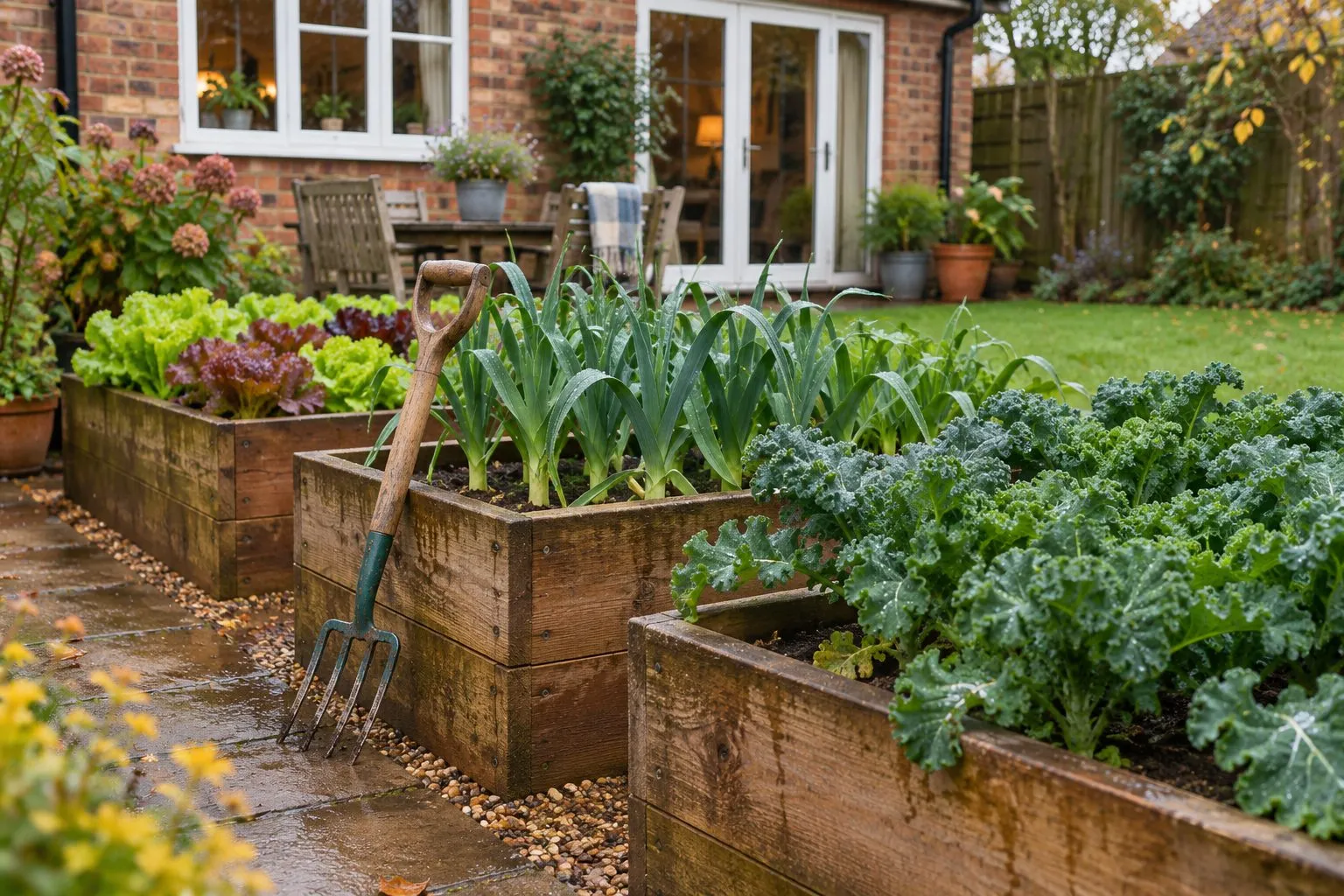
A bed of salad, beans and potatoes won't feed a family through a crisis. But growing some of what you eat is a good habit, it's cheering, and it means there's always something fresh. Here's how to start small.
Buying through our links costs you nothing extra. Some of them earn us a small commission, and that's what keeps the site going: it pays for the time it takes to keep our picks and figures up to date. Thank you for helping. How we choose and how we earn.
Do you need a raised bed at all?
Not necessarily. The RHS says vegetables grow just as well in the ground (opens in a new tab). A raised bed earns its place when your soil is poor, heavy or wet, when you want to grow on a hard surface, or when bending and kneeling are hard. The soil in a raised bed also warms up sooner in spring, and it keeps plants closer to hand.
If you have a sunny patio and a few large pots, you can grow potatoes, dwarf beans, salads and herbs in those first, and see how you get on.
Width: under 1.5 m, so you can reach the middle without standing on the soil. If you can only reach from one side, make it narrower.
Depth: about 30 cm is enough for salad leaves and strawberries. Bigger plants such as fruit bushes need 45 cm or more.
Paths: at least 45 cm for a wheelbarrow, and at least 1 m if someone uses a wheelchair.
Height: a tall bed, or a planter on legs, saves bending. Check you can reach it comfortably, and that there's room for your knees if you garden from a chair.
Timber, metal or something else?
Pressure-treated timber is the usual choice: it's easy to work with and lasts for years. Coated steel kits are slim, tidy and don't rot. Bricks, stone, scaffold boards and recycled plastic all work too. Whatever the frame, the soil matters more.
Filling it, and what it costs
The filling often costs more than people expect, because a bed holds a lot. The RHS suggests a mix of about seven parts topsoil, three parts organic matter (such as compost) and two parts sharp sand.
To fill the kits below
320 litresat most for the steel bed, worked out from its outside size (120 x 60 x 45 cm)
420 litresfor the planter on legs
94 litresworked out for the 90 cm square frame at 14 cm deep, plus the dug soil beneath it
The square frame is measured over its 40 mm timber sides, so inside it's about 82 cm square. For any kit, work it out from the inside measurements and the soil depth.
Price the topsoil and compost, and the delivery, before you choose a kit. Then add seeds, plant food and water through the season.
Will it save money?
Savings depend on what you grow, how well it does and what you'd otherwise buy, and we found no reliable UK figure. The best way to find out is to keep a simple notebook: write down what you pick and what it would have cost in the shop, and take away what you spent on the bed, the filling, seeds, plant food and water.
When to sow
These are the RHS's general timings. In colder parts of the UK, start later; in milder areas, a little earlier. Always check the seed packet.
When to sow and harvest
Crop
Sow or plant
Ready to pick
Radishes
Spring, early summer and late summer. From February under cloches.
About 4-6 weeks after sowing
Lettuce and salad leaves
Outdoors late March to late July, a short row every two weeks. Winter types in September or October under cover.
Leaves from about 4-6 weeks
Beetroot
Late March or April to July, once the soil has warmed
Early summer to mid-autumn
Dwarf French beans
Indoors from late April; outdoors late May or early June, after the last frost
Through summer, for several weeks
First early potatoes
Plant around late March (start them sprouting from late January to early March)
Build the bed in winter, so it's ready for spring. On heavy clay, the RHS suggests late summer instead, when the ground is drier. Want to start earlier and grow tomatoes too? See polytunnel or greenhouse.
Three raised bed kits worth a look
From a first small bed to one you can use standing up. Prices checked 4 November 2026. Filling not included.
Forest Garden Caledonian Compact Raised BedA first small bed
A square frame of pressure-treated timber, 90 cm across, with a 15-year guarantee. It's only 14 cm high, so it works by sitting on ground you've dug over, not on a patio. Good for a first season of salads and radishes.
Harbour Housewares Metal raised bed, 120 x 60 x 45 cm, rounded, greenDeeper
A powder-coated galvanised steel bed, 120 x 60 cm and 45 cm high, with rounded corners and no base. From its outside size, filling it takes up to about 320 litres of soil (a little less with the rounded corners), so budget for that.
Size
120 x 60 cm, 45 cm high
Soil needed
Up to about 320 litres (worked out from the outside size)
A cedar trough on legs, 80 cm high, so you can garden standing up or from a chair. It's V-shaped, deepest in the middle and shallower at the sides, and needs 420 litres of compost to fill.