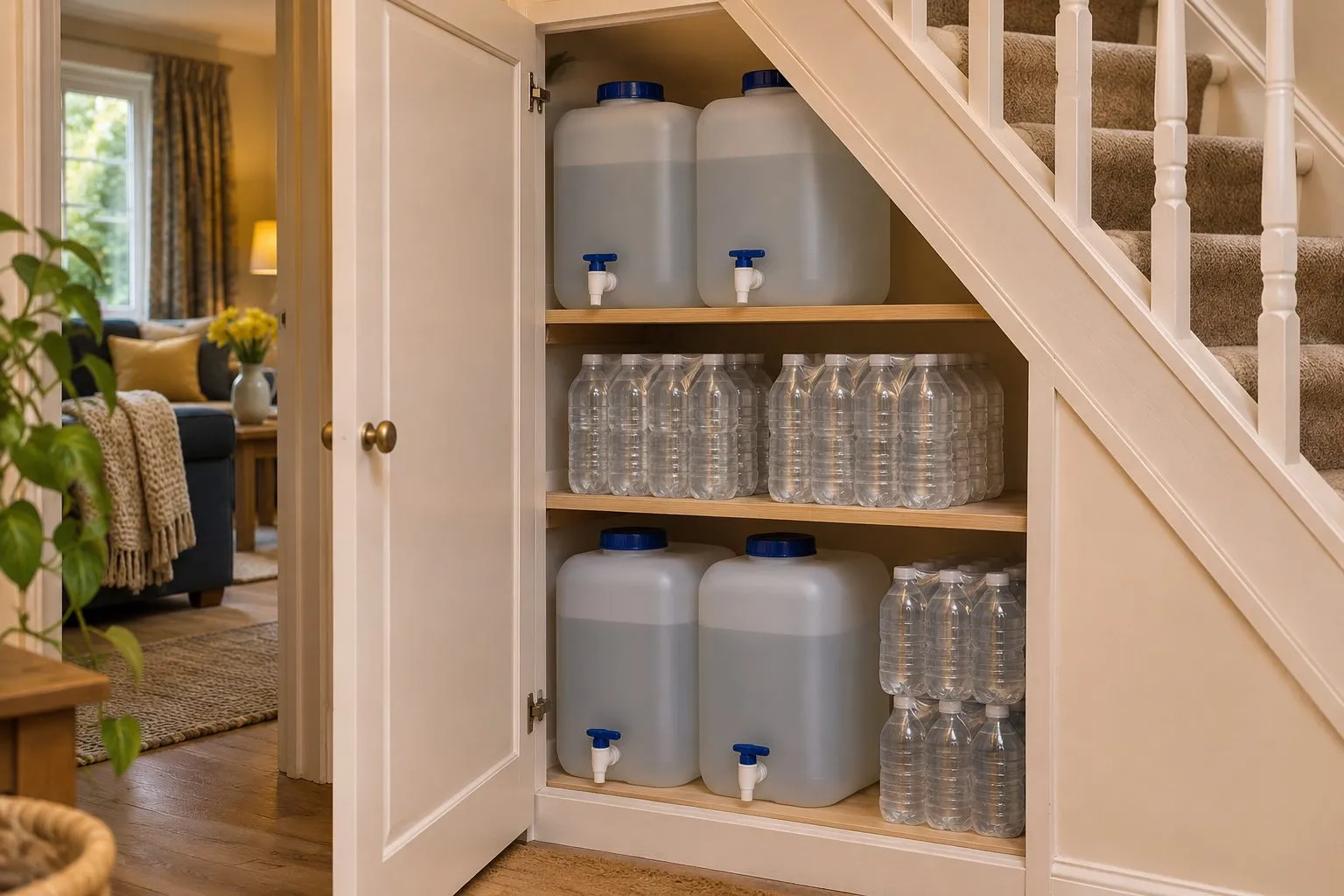
The UK government's Be Ready guidance suggests 3 litres of drinking water per person per day, for three days. That's 9 litres each, and it recommends bottled water.
Buying through our links costs you nothing extra. Some of them earn us a small commission, and that's what keeps the site going: it pays for the time it takes to keep our picks and figures up to date. Thank you for helping. How we choose and how we earn.
How much does your household need?
That's 18 litres: 2 people × 3 days × 3 litres. That's about 1 container of 20 litres, or 9 two-litre bottles.
Be Ready notes that pets, baby formula and medical devices can need more. Each litre weighs a kilogram, so 20 litres weighs 20 kg.
Drinking, cooking and basic washing: the government's earlier Prepare guidance gave 10 litres per person per day for all three, and Which? (opens in a new tab) still quotes it as "most comfortable". That's 30 litres each for three days. Be Ready, which replaced Prepare in October 2026, gives 3 litres for drinking and says more is needed for cooking and washing.
Extra: Be Ready adds water for pets, baby formula and medical devices.
Bottled water or tap water?
Be Ready recommends bottled water. It's sealed and dated, and it can be drunk and replaced as it goes. Each brand's label gives its storage: Highland Spring's, for example, says away from direct sunlight and strong smells.
Filling containers from the tap is cheaper. For an announced cut, South West Water (opens in a new tab) suggests filling bottles and containers while the taps still run, ideally that morning.
How long can you store tap water?
There's no official UK figure for tap water stored in a sealed container at home. The official figures that exist are short: the Drinking Water Inspectorate says to throw away water kept in a jug in the fridge after 24 hours, and Bristol Water explains why: "Removing the chlorine will mean the water is no longer protected against bacterial growth."
The "six months" often quoted online comes from container sellers and prepping sites, not water companies. Container makers give their own intervals: Reliance, for example, says to empty, clean and refill its containers every 90 days.
And bottled water?
Until its best-before date, stored as the label says. The government's food-labelling guidance says best-before dates "relate to quality" and use-by dates to safety. While the mains is off, Be Ready suggests keeping bottled water solely for drinking, washing hands and preparing food.
Choosing containers
Made for drinking water. Containers sold for drinking water say so, or say food-grade. "BPA-free" on its own isn't the same statement.
Bottled-water labels and container makers' care notes give the storage conditions, typically cool and dark, out of sunlight. Bottled water carries a best-before date; household-filled containers have the maker's replacement interval. The British Red Cross (opens in a new tab) suggests checking an emergency kit regularly.
Boil-water notices
A boil-water notice means germs may have got into the supply. The Drinking Water Inspectorate's guidance (opens in a new tab) is to boil tap water for drinking, cleaning teeth, ice, food, feeding equipment and pets; to bring it to a rolling boil and let it cool naturally; and to keep it in a clean container in the fridge, using it within 24 hours. It says showers, baths, laundry and flushing carry on as normal. Your water company's notice may add its own instructions.
A "do not drink" or "do not use" notice is different: UKHSA notes that boiling doesn't remove chemicals, and the company provides bottled or tanker water.
Baby formula
Be Ready names ready-to-feed formula as the best option in an emergency. For powdered formula, the NHS guide (opens in a new tab) covers making it up.
A drum that rolls along the ground on its own body, so you can move 40 litres without lifting it. Hitchman says Aquarolls are made from "certified food grade materials", and the shop calls it a food-grade container, though Parkers advises against storing drinking water in one. Handy for fetching water from a tanker or standpipe. Full, it's for rolling rather than carrying, and pouring from it indoors needs a separate stand and tap.
Holds
40 litres
Material
Food-grade high-density polyethylene
Moving it
Rolls along on its own wheel-shaped body, with a removable handle
A food-grade container with a tap and two handles, so it can sit on a worktop and dispense. On 4 November it was on pre-order, expected in February 2027.
These fold flat when empty, so they're good for fetching water from a tanker or standpipe, or for a store where space is tight. They're less sturdy than a rigid can.
Sea to Summit Watercell X 10L
A tough fabric bag with a food-grade lining that packs down small when empty. Good for a smaller store, or for carrying water home.
Holds
10 litres
Material
400D fabric with a food-grade TPU lining, BPA and PVC free
A low-cost folding carrier with a tap in the lid. The shop describes it as food-grade polyurethane. Useful as a spare for collecting water from a standpipe.