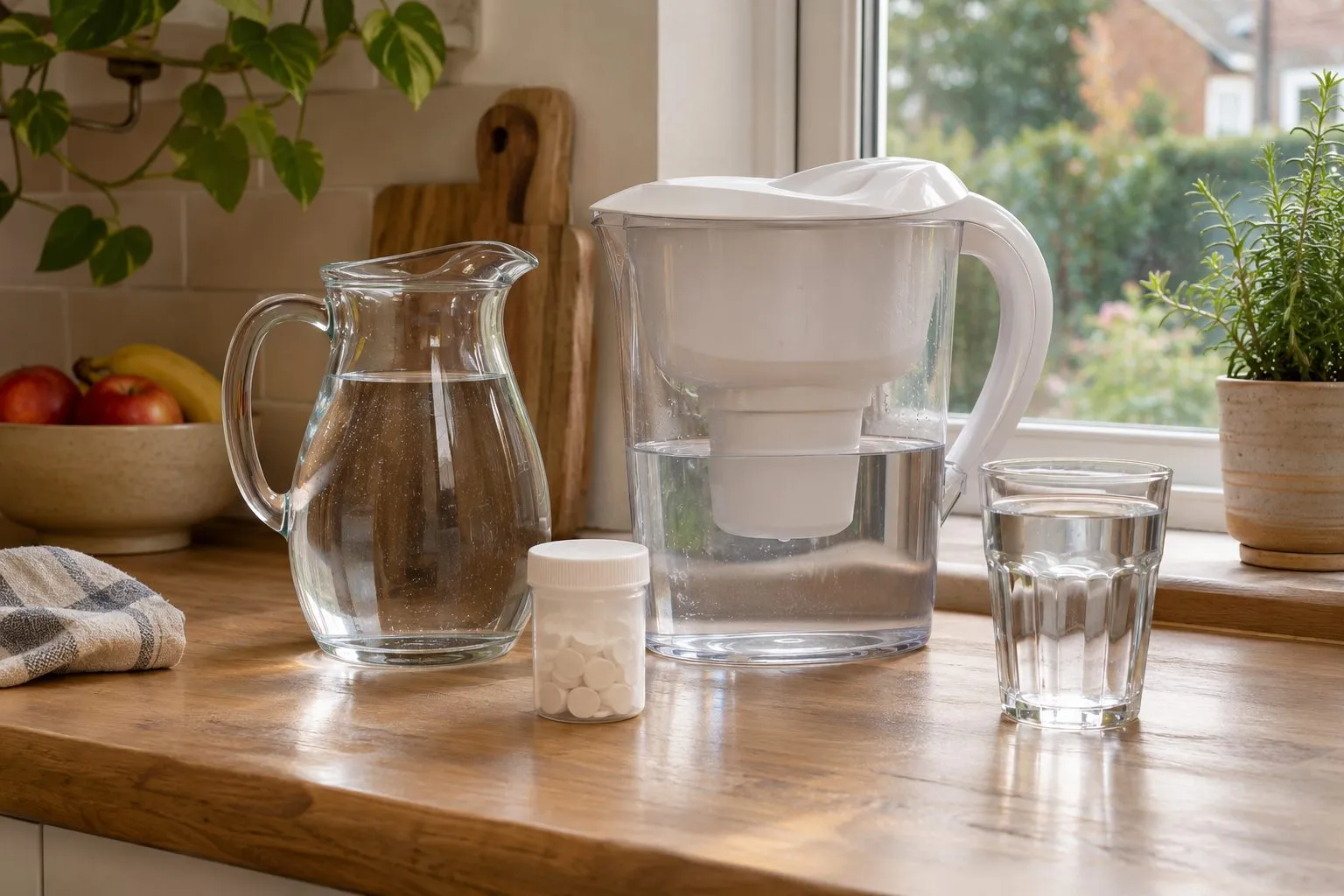
Water purification tablets and portable water filters
The government's Be Ready guidance (opens in a new tab) puts stored bottled water first. A filter or a pack of tablets is a back-up, for water that might not be clean. Each one deals with some things and not others, as the table shows.
Buying through our links costs you nothing extra. Some of them earn us a small commission, and that's what keeps the site going: it pays for the time it takes to keep our picks and figures up to date. Thank you for helping. How we choose and how we earn.
Filters, tablets and water notices
If there's a problem with tap water, your water company issues one of three notices, and the notice decides what helps.
Boil water: germs may be in the supply, and the Drinking Water Inspectorate's guidance is to boil tap water for drinking, teeth, ice, food, feeding equipment and pets. LifeStraw itself says boiling carries on during a boil-water notice, filter or not. More on boil-water notices.
Do not drink or do not use: the problem may be chemical. Boiling, tablets and most filters don't remove chemicals, so the company provides bottled or tanker water.
In an outage, Be Ready says boiling or purification tablets can make other water safer to drink. Water-butt water is for the garden and the toilet, not for drinking.
What each one deals with
Method
Bacteria
Parasites (Giardia, Cryptosporidium)
Viruses
Chemicals and metals
Boiling (a rolling boil)
Yes
Yes
Yes
No
Microfilter (most portable filters, such as LifeStraw and Sawyer)
A microfilter strains out bacteria and parasites through very fine holes, but viruses are small enough to pass through. Most portable filters, including the LifeStraw Peak and the Sawyer Squeeze, are microfilters. A purifier also removes viruses, and some reduce certain chemicals. Each has a stated range: GRAYL, for example, lists salty water, industrial or nuclear incidents and blue-green algae as outside what its purifier is for. None of the filters here removes salt.
A tiny micron figure on the box is about germs, not chemicals. Sawyer says its Squeeze doesn't remove metals, chemicals, pesticides or salt.
Tablets: dose, waiting time and shelf life
Each pack gives its dose by volume and a waiting time; tablets work best in clear water, and some packs give longer times for cold or cloudy water. Shelf life differs: Lifesystems gives up to five years unopened for its chlorine tablets and two for chlorine dioxide; check the expiry printed on the pack.
Running costs of a filter
Filters and cartridges have a stated life (up to 2,000 litres for the LifeStraw Peak SOLO, about 250 litres or three years for a GRAYL cartridge), and each maker gives its own cleaning and replacement schedule. Sawyer says to replace a Squeeze that may have frozen while wet.
Which suits a household?
The portable filters here are built for one person outdoors, a bottle at a time. For a household, stored water is the main thing in the government's guidance, and a pack of tablets is a cheap back-up. How much water to store.
A small, light microfilter that screws onto most bottles. It removes bacteria and parasites, but not viruses or chemicals. A good, cheap back-up for one person; not a household supply.
Type
Microfilter (hollow fibre, 0.2 micron)
Removes
Bacteria and parasites; not viruses or dissolved chemicals
Lifesystems Chlorine Dioxide Water Purification Tablets (30)
Chlorine dioxide, which works better against parasites than chlorine; Lifesystems says it treats Cryptosporidium too. Dearer, with a shorter shelf life, and the waiting time varies with the water, as the pack sets out.
Type
Chlorine dioxide
Treats
Bacteria, viruses, Giardia and Cryptosporidium (maker's claim)