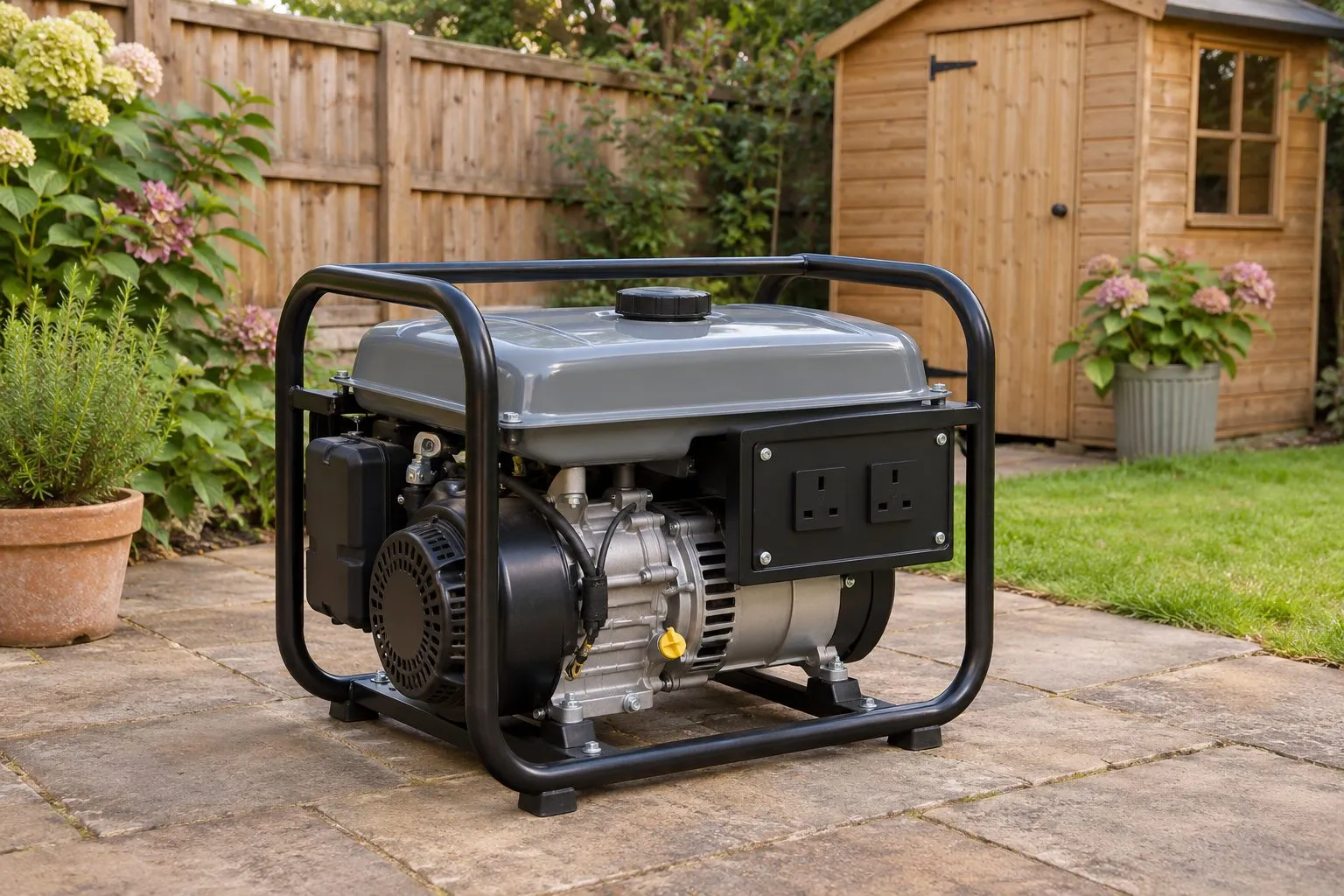
For a power cut, buy an inverter generator of about 2 kW: it runs a fridge-freezer, lights, the router and a TV, gives clean enough power for phones and laptops, and is quieter than a site generator. The Hyundai HY2250SEi does that for £463.99, though Amazon lists it as dispatched within 1 to 2 months; the Pramac PMi 2500 is the same size and was in stock. For more power, the Pramac P3500i and Sealey G3500I give 3 kW or more running, with two UK sockets. A generator only powers what's plugged into it: wiring one into the house is a job for an electrician.
Buying through our links costs you nothing extra. Some of them earn us a small commission, and that's what keeps the site going: it pays for the time it takes to keep our picks and figures up to date. Thank you for helping. How we choose and how we earn.
Our picks
For most homesHyundai HY2250SEi2,000 W, two UK sockets and electric start. Amazon lists it as usually dispatched within 1 to 2 months (checked 15 November). If you need one sooner, the Pramac PMi 2500 was in stock.See today's price at Amazon (opens in a new tab)
Running is what a generator can supply for hours; peak is a burst of a few seconds, for a fridge or a pump starting. Size by the running figure. Makers measure noise at different distances and loads, so the figures don't compare well.
Cost per hour at the UK average of 170.71p a litre for the week of 9 November 2026, from the government's weekly figures: petrol prices this week. Makers' fuel figures don't always match their tank sizes and run times.
Inverter or conventional?
An inverter generator's electronics smooth its output. Champion's UK page gives its petrol inverter "True Sine wave technology (<3% THD)", the measure of how distorted the supply is; Champion's own guidance puts its conventional generators at "about 12%-20% depending on load applied". Honda says inverter power is "ideal for powering the most sensitive electronic equipment". Inverters often have an eco mode that slows the engine at light loads, which Honda says saves fuel and noise. A conventional generator gives more watts for the money.
Noise figures
Most makers quote noise at 7 metres, but at a load they often don't state, and some don't give the distance at all. Champion explains that the sound power figure on the label (LWA) "is a different measurement of sound", so it can't be compared with a 7 m figure either.
Where to run it
Outside. National Grid says: "To stay safe, never use a portable generator or barbeque indoors during a power cut or planned interruption to your supply." The Health and Safety Executive for Northern Ireland adds: "Do not use a generator indoors or in partially enclosed spaces- including homes, garages, and crawl spaces." National Grid (opens in a new tab), HSENI (opens in a new tab).
30 litresthe most you can store without telling your Petroleum Enforcement Authority
10 litresthe largest plastic container allowed
20 litresthe largest metal container allowed
In Great Britain, the Health and Safety Executive says: "You can store up to 30 litres of petrol at home or at non-workplace premises without informing your local Petroleum Enforcement Authority (PEA)." Its rules for portable containers set a maximum of "10 litres if made of plastic" and "20 litres if made of metal", and petrol mustn't be kept in living accommodation. Petrol in a car's tank doesn't count. Storing more than 30 litres and up to 275 litres needs written notice to the authority, and more than 275 litres a licence. HSE (opens in a new tab).
Northern Ireland's limits are lower: for a domestic garage or within six metres of a building, HSENI allows two metal containers of up to 10 litres, or two approved plastic ones of up to 5 litres, and says "Under no circumstances should the petrol containers be stored in the home itself." HSENI (opens in a new tab).
Petrol goes stale. Honda says fuel stabiliser "must be added when the gasoline is fresh" because it "will not reconstitute or reinvigorate stale gasoline", and Honda UK advises draining the fuel system if a machine is stored for a long time.
The generators
Hyundai HY2250SEiOur pickFor most homes
2,000 W running and 2,200 W peak, two UK sockets, electric start and a 6-litre tank that Hyundai says lasts 7.5 hours at half load. Enough for a fridge-freezer, lights, the router and a TV, not a kettle.
Amazon lists it as usually dispatched within 1 to 2 months (checked 15 November). If you need one sooner, the Pramac PMi 2500 was in stock.
2,000 W running and 2,300 W peak, with two UK sockets, two USB ports and a 12 V outlet, at 22.5 kg. Enough for a fridge-freezer, lights, the router and a TV, not a kettle. Pramac gives up to 3.6 hours from its 3.5-litre tank at half load, so it needs refilling more often than the Hyundai.
3,000 W running and 3,300 W peak, two UK sockets, electric start and a 10-litre tank. Pramac gives 61 dB at 7 m, level with the Hyundai for the lowest figure here. At 49.5 kg it's a two-person lift. Pramac gives 6 hours from the tank at three-quarter load.
3,200 W running and 3,500 W peak, with two UK sockets, two USB ports, electric start, and wheels with a folding handle, since it weighs 44 kg. Sealey gives 8.5 hours from its 8.3-litre tank at half load. Enough for the essentials and a microwave together, which our sizing method puts at about 2,600 to 2,850 W.
A power station has no engine noise (though its fans can be heard), works indoors and needs no fuel, but runs out. A generator keeps going as long as you have petrol. For most cuts of a day or less, a power station is simpler: generator or power station? To size either, what size generator do you need?