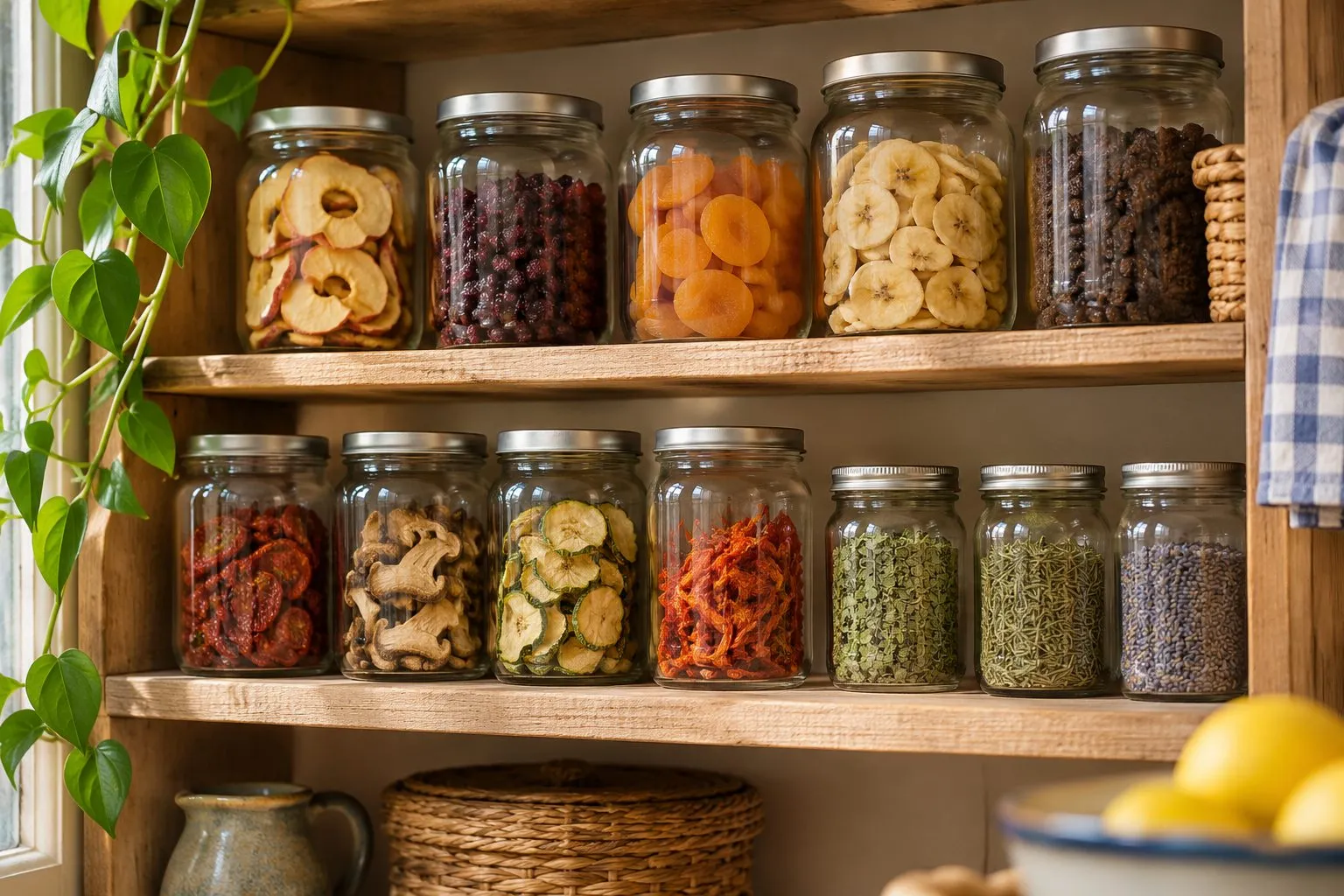
Freeze dryer vs dehydrator
A dehydrator dries food with warm air. A freeze dryer freezes it, then turns the ice straight to vapour in a vacuum, so the food ends up drier and, the makers say, keeps far longer. But a freeze dryer costs about £2,500 for the smallest home machine sold in the UK, against £29.99 upwards for a dehydrator, takes 13 to 40 hours a batch by Harvest Right's estimates, and uses more electricity. For drying a garden surplus, a dehydrator does the job.
Buying through our links costs you nothing extra. Some of them earn us a small commission, and that's what keeps the site going: it pays for the time it takes to keep our picks and figures up to date. Thank you for helping. How we choose and how we earn.
Our picks
- DehydratorHendi Profi Line 6-tray stainless steel dehydrator (229033)Six stainless steel trays, 35-75°C and a 24-hour timer.See today's price at Amazon (opens in a new tab)
- Cheap dehydratorVonShef 5-tier food dehydratorFive stacking trays and an adjustable thermostat, for under £50.See today's price at Amazon (opens in a new tab)
Side by side
| Dehydrator | Freeze dryer | |
|---|---|---|
| How it works | Warm air blown over trays of thinly sliced food | Freezes the food, then removes the ice as vapour under a vacuum |
| Water taken out | 80-90%, says Iowa State University Extension | Up to about 98-99%, says Harvest Right |
| How long the food keeps | 4 months to a year, says the US National Center for Home Food Preservation; Excalibur claims years | "Up to 25 years or more", claims Harvest Right; no independent long-term trial of home freeze-dried food has been published |
| Time per batch | 7-15 hours for apple rings, in Excalibur's manual | 13-35 hours for most foods in Harvest Right's FAQ (20-40 on another of its pages) |
| Electricity per batch | At most 4.5-10 kWh (£1.20-£2.57) for a machine rated at 650 W | About 21 kWh (£5.53), one owner's metered average |
| Price in the UK | From £29.99 | About £2,500 for the smallest Harvest Right |
| Size | Sits on a worktop | 41-54 kg for the Harvest Right Small and Medium, plus a separate vacuum pump |
| Upkeep | Wash the trays | Pump oil changed every 20-30 batches (Premier pump), or changed and filtered every 4-5 (Standard pump), says Harvest Right |
At 26.32p per kWh, the price cap rate for Direct Debit, 1 October to 31 December 2026: the price cap explained. The dehydrator figure is the most a 650 W machine could use over Excalibur's drying times. The freeze dryer figure is Dennis Alexander's (opens in a new tab) metered average for his 2016 Harvest Right Medium.
How each one works
A dehydrator blows air, warmed to a set temperature, across sliced food for hours until most of the water has gone. Dried apple, tomatoes, herbs, mushrooms and fruit leather are the usual things to make.
A freeze dryer freezes the food first, then pumps the air out of its chamber. In a vacuum the ice goes straight from solid to vapour, what Utah State University Extension (opens in a new tab) calls "the direct transition of a solid to a gas", and gentle heat speeds it along. Whole meals, fruit and dairy can be dried, then brought back with water. Drew Smith at Backpacking Light (opens in a new tab) found his freeze-dried meals "rehydrated in 5-20 minutes in cold water".
Which keeps food longer?
Freeze-dried food, because it holds less water. But the long figures you'll see come from the makers. Harvest Right says freeze-dried food keeps "up to 25 years or more when properly packaged and stored". Utah State University Extension doesn't agree:
“No real data exists on the shelf-life of home freeze-dried products.”
For home-dried food from a dehydrator, the National Center for Home Food Preservation (opens in a new tab) recommends "4 months to 1 year", depending on the food and how cool it's kept; vegetables keep about half as long as fruit.
Excalibur's own chart gives 3-5 years for most fruit and 8-10 years for most vegetables in airtight containers below 21°C, far longer than the NCHFP's advice.
For food you can count on in an emergency, shop-bought tins and dried food with printed dates are simpler: a store cupboard that sees you through.
What each does badly
Freeze dryers
- Fat and sugar. Harvest Right says plain butter, peanut butter and solid chocolate don't freeze-dry well on their own, and advises against honey, syrup and jam: "Freeze drying removes water, but oil remains." Utah State (opens in a new tab) says thick meat or casseroles can take "more than 2 days".
- It doesn't cook anything. Utah State says freeze drying doesn't kill germs, "It preserves them", so raw meat and eggs still need cooking, before drying or after.
- Noise and upkeep. Drew Smith found that the vacuum pump "is noisy", and drained water and topped up oil after each run on his older machine. Harvest Right wants clear space round the side vents, and a room at 50-75°F (10-24°C).
- Size and price. It's a heavy machine that runs for 13 to 40 hours a batch, and costs many times as much as a dehydrator.
Dehydrators
- Shorter keeping time, by the NCHFP's guidance above, because more water stays in the food: it gives about 20% left in dried fruit and about 10% in vegetables.
- Slices, not meals. Food has to be cut thin: Excalibur's drying times are for quarter-inch apple slices.
Packing it to keep
Utah State (opens in a new tab) recommends packing freeze-dried food straight away, in opaque "Thick Mylar bags (5–7 mil)" with oxygen absorbers, stored cool, dark and dry. Its buying guide (opens in a new tab) adds that vacuum packing and oxygen absorbers are only for food that's properly dry: "vacuum packaging is not a food safety process itself".
For dehydrated food the NCHFP (opens in a new tab) says to cool it fully, then pack it in clean, dry, insect-proof containers such as jars, kept in "cool, dry, dark areas".
The dehydrators
Hendi Profi Line 6-tray stainless steel dehydrator (229033)Our pickDehydrator
Six stainless steel trays in a cabinet with a fan that circulates the warm air, so the trays needn't be turned. 35-75°C in 5° steps, a timer up to 24 hours, and a clear door. Hendi rates it at 650 W.
- Trays
- 6 stainless steel, 30.5 x 33 cm (about 0.6 m², 6.5 sq ft in all), with a fan circulating the air
- Power
- 650 W
- Temperature
- 35-75°C, in 5° steps
- Timer
- Up to 24 hours
- Size
- 34 x 49 cm, 31 cm high
VonShef 5-tier food dehydratorOur pickCheap dehydrator
Five stacking trays over a fan and heater, 40-70°C, at 245 W. Its manual says not to run it for more than 40 hours at a time.
- Trays
- 5 stacking trays
- Power
- 245 W
- Temperature
- 40-70°C
- Size
- 33 x 26 cm, 29 cm high
- Limit
- 40 hours at a time
Is a freeze dryer worth it?
Only if you'll use it often: a big garden, an allotment or orchard, or meals for walking and camping. Electricity alone is about £5.53 a batch at today's price cap, on one owner's measurement, before bags, oxygen absorbers and pump oil. For an occasional surplus of fruit and herbs, a dehydrator at a fraction of the price is the sensible start. More on dehydrators: dehydrators and vacuum sealers.
Sources: Iowa State University Extension (opens in a new tab), Utah State University Extension (opens in a new tab), the National Center for Home Food Preservation (opens in a new tab), Harvest Right, Excalibur (Performance series manual (opens in a new tab)), and the hands-on reports linked above.