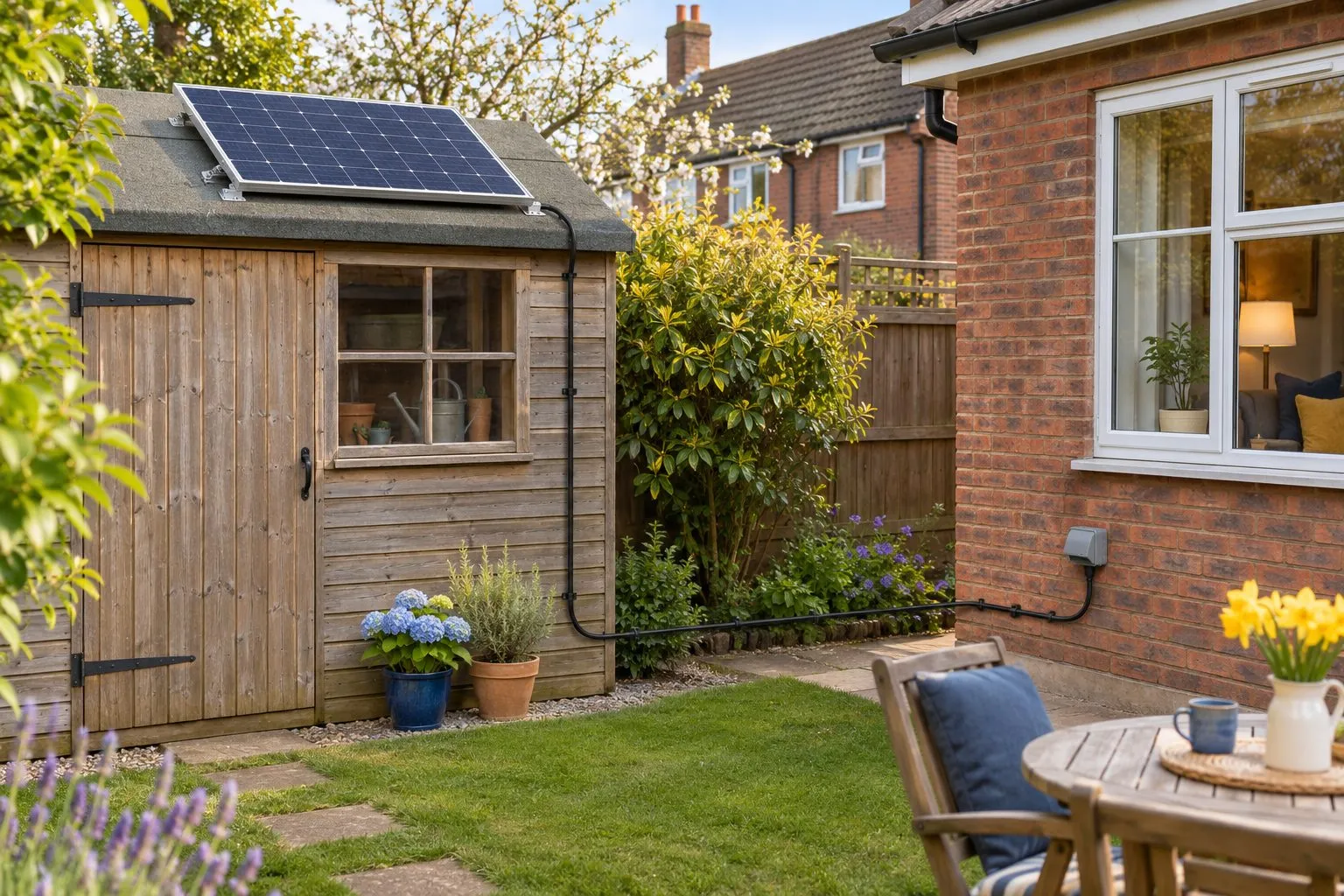
How do plug-in solar panels work?
A plug-in solar kit is one or two solar panels and a small box called a microinverter, which turns the panels' power into mains electricity and feeds it into your home through an ordinary plug socket. Whatever your home is using at the time, a fridge, a router, the washing machine, takes that power first, so you buy less from the grid. They've been legal in Great Britain since 27 August 2026.
Buying through our links costs you nothing extra. Some of them earn us a small commission, and that's what keeps the site going: it pays for the time it takes to keep our picks and figures up to date. Thank you for helping. How we choose and how we earn.
The short version
- Legal in England, Scotland and Wales since 27 August 2026; not yet in Northern Ireland.
- One kit per home, with up to four panels and up to 800 W going into the socket.
- Kits cost from about £450 to £1,000. One panel saves about £47 to £126 a year at today's price cap (working below).
- It does not work in a power cut. The inverter switches off when the grid goes down.
How they work
The panels make direct current. The microinverter turns it into 230 V alternating current matched to the mains, and sends it down a lead with a UK plug into a wall socket. From there it flows round your wiring to whatever is switched on. If the panels make more than the house is using, the extra goes out to the grid, usually unpaid. The rules cap what goes into the socket at 800 VA, so on a bright day a bigger set of panels just runs the inverter at its limit for longer.
Is plug-in solar legal in the UK?
Yes in Great Britain, from 27 August 2026, under new regulations (SI 2026/848). Not yet in Northern Ireland: the Energy Saving Trust says they "aren't currently legal to use in Northern Ireland", which has its own regulations still to be changed. In Britain a kit must meet the government's plug-in solar product specification. The main rules:
- It's sold as a complete kit: panels, inverter, a lead with a moulded UK plug fused at no more than 5 A, and a mount.
- At most 800 VA goes into the socket, from up to 2,000 W of panels.
- It plugs straight into a wall socket on a socket circuit. The rules ban extension leads and adaptors.
- No built-in battery, and it isn't to be used with one.
- Not on timber balconies, timber cladding or certain other cladding.
- The maker must have the kit verified as compliant on the Energy Networks Association's register before it goes on sale.
- You register it with your network operator through the UK plug-in solar registration site. The Energy Saving Trust says to do it before you use it; MoneySavingExpert and Which? say within 28 days of plugging in.
Renting, or in a leasehold flat? The Energy Saving Trust says to get permission from your landlord, freeholder or building manager before you buy.
How many plug-in solar panels can you have?
One kit per home for now, but the kit can have up to four panels, up to 2,000 W in total. The current grid connection rules limit each household to one device, though the government is looking at allowing more. Whatever the number of panels, no more than 800 VA goes into the socket. The specification says that with more than 960 W of panels you should consider having an electrician assess your wiring first.
How much do plug-in solar panels cost?
The Energy Saving Trust says "from around £450". If your wiring needs a check or you need an outdoor socket, Which? and MoneySavingExpert put that at another £100 to £260 or so for each.
Are plug-in solar panels worth it?
For most homes they save a modest amount. The government says up to £110 a year; the Energy Saving Trust works out about £70 to £100 for an 800 W system in Manchester, more if someone's home in the day. Which? says that if you own a house with a suitable roof and aren't moving, it's worth comparing rooftop solar.
Our working for one 460 W panel
- 299 to 534 kWhmade a year
- £47 to £126saved a year at 26.32p per kWh
- 4 to 10 yearsto pay back a £450 kit
Facing south, a kilowatt of panels makes roughly 650 kWh a year hung upright in Manchester and 1160 angled on the south coast, by the EU's PVGIS figures. Facing east or west, further north, or in shade, it makes less. That's about 299 to 534 kWh a year from one panel.
You save money on the electricity you use at the moment it's made. If 60-90% of it is used at home, and the rest goes to the grid unpaid, at the capped rate of 26.32p per kWh that's about £47 to £126 a year. A £450 kit would pay for itself in roughly 4 to 10 years.
The yield range and the share used at home are our assumptions. For your own home, try the plug-in solar calculator.
Do plug-in solar panels work in a power cut?
No. The specification requires the inverter to switch off within a tenth of a second when the mains goes, so it can't send power down a line engineers may be working on. For power in a power cut you need a battery, such as a portable power station, which can be charged from its own folding panels. Roof panels are covered in do solar panels work in a power cut?
Can you add a battery?
Not on the plug-in route. Kits with a built-in battery aren't covered, and the instructions must warn against using one with a battery. Home batteries that are wired in by an electrician are a separate thing. Some sellers describe their kits as "battery compatible"; the specification says not to use one with a battery.
What about Lidl?
Lidl hasn't put a plug-in solar kit on sale in Britain yet. What we know about Lidl plug-in solar.
Kits on sale now
Checked 15 November 2026. Stock has been patchy since launch.
Voltacon Plug-in solar kit, 2 x JA Solar 465W, Hoymiles HMS-800-2WB, ground mount
Two 465 W JA Solar panels (930 W), a Hoymiles HMS-800-2WB microinverter that tracks each panel separately, a ground or flat-roof frame and a 5 m lead with a UK plug. On the register as VOLTD/21738, compliant.
Solarfy Duo 910W plug-in solar kit, 2 x JA Solar 455W, Hoymiles HMS-800-2WB, flat mount
Two 455 W JA Solar panels (910 W) with the same Hoymiles HMS-800-2WB microinverter, a flat mount and a 5 m lead with a UK plug. On the register as SOLAW/21608, compliant. The seller, Solarfy, is new and has no Amazon ratings yet.
Register entries from the Energy Networks Association's type test register (opens in a new tab), read on 15 November 2026. Kits are added and changed, so check the entry for the exact kit before you buy.
Sources: the government's plug-in solar product specification (opens in a new tab), SI 2026/848 (opens in a new tab), the Energy Saving Trust's plug-in solar advice (opens in a new tab) and checklist (opens in a new tab), MoneySavingExpert (opens in a new tab) and Which? (opens in a new tab).