EcoFlow DELTA 3: which one, and what it runs
For most homes the standard DELTA 3 is the one to buy. It's the same 1 kWh, 1,800 W power station as the DELTA 3 Plus, with four UK sockets and a switchover of under 10 ms, for £50 less. The Plus adds faster solar charging, faster USB ports and a link that tells a computer the mains has gone. On 4 November it was on pre-order until December.
Buying through our links costs you nothing extra. Some of them earn us a small commission, and that's what keeps the site going: it pays for the time it takes to keep our picks and figures up to date. Thank you for helping. How we choose and how we earn.
- 1,024 WhBattery capacity
- 1,800 WContinuous output
- 4UK sockets
- 8.4 h to 32 hA fridge-freezer, router and two phones
The short answer
What it runs in a power cut
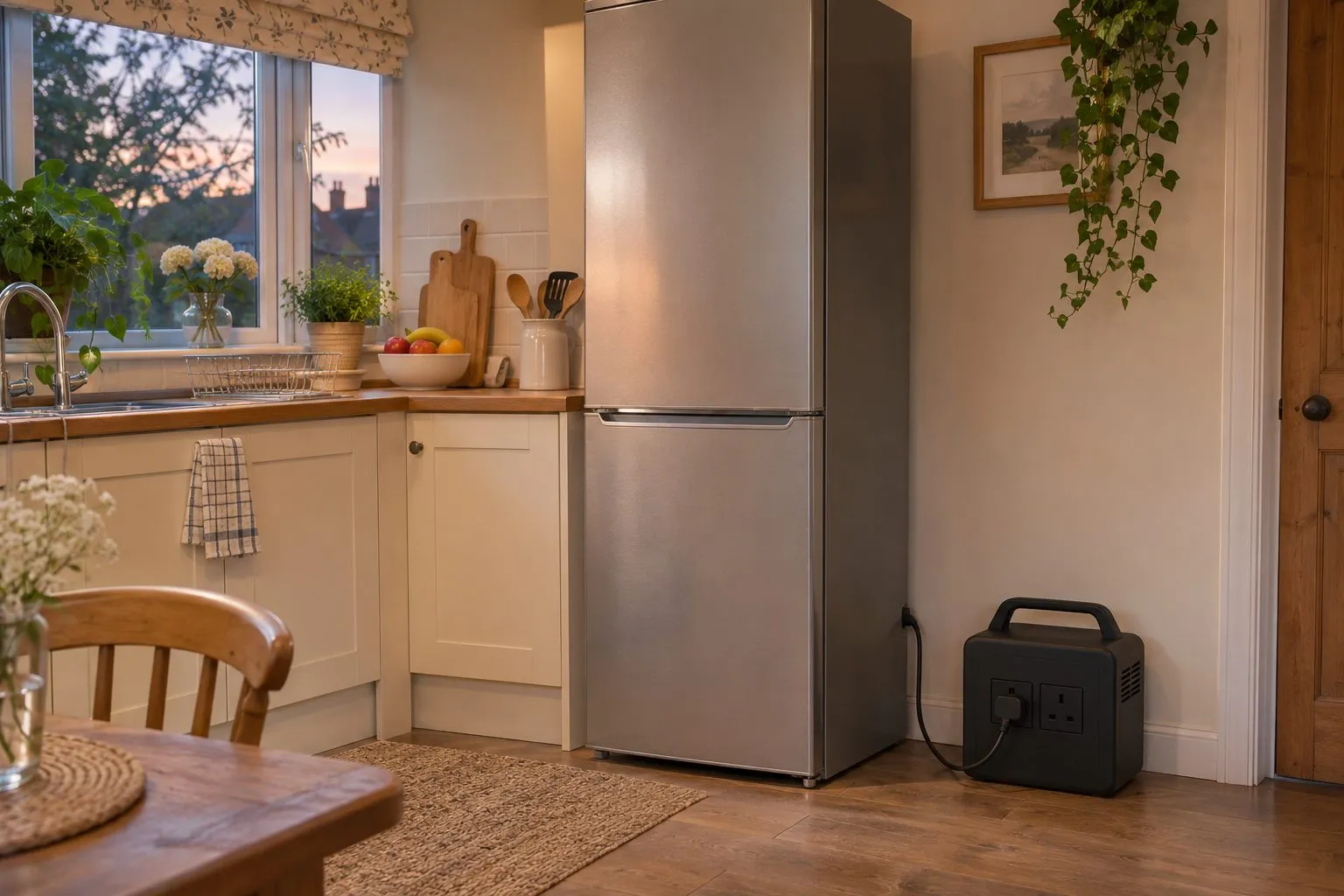
A DELTA 3 keeps a modern fridge-freezer, a router and two phones going for 8.4 h to 32 h, depending on how hard the fridge works. The DELTA 3 Plus gives the same figures: it has the same battery and inverter.
| What's plugged in | EcoFlow DELTA 3 Classic | EcoFlow DELTA 3 | EcoFlow DELTA 3 Max |
|---|---|---|---|
| Router, fibre box, 2 phones and a lamp | 16 h to 46 h | 16 h to 46 h | 33 h to 3.5 days |
| Fridge-freezer, router and 2 phones | 8.4 h to 32 h | 8.4 h to 32 h | 17 h to 2.5 days |
| Fridge-freezer, router, 2 phones, TV and 2 lamps | 6.5 h to 25 h | 6.5 h to 25 h | 13 h to 2 days |
| Fridge-freezer and chest freezer | 5.5 h to 22 h | 5.5 h to 22 h | 11 h to 43 h |
Our estimates from the sizer, as a range from heavy to light use, allowing for the energy lost in the power station itself. A modern fridge-freezer uses 0.4-1.5 kWh a day depending on the model and the weather. Try your own list in the sizer.
The estimates allow 5-15 W for the power station's own use while it's on. The Solar Lab measured more on US models: about 17 W on the Classic and 27 W on the Max, which would shorten the longest runtimes here, by a day or more on the Max with a light load.
It won't run a kettle (about 3,000 W) or a 2 kW fan heater: both draw more than its 1,800 W. The 2,400 W "X-Boost" figure on the box runs some heating appliances at reduced voltage, so they work more slowly; it isn't 2,400 W of normal output.
The DELTA 3 models compared
| Model | Battery | Output | UK sockets | Mains charging | Solar input | Extra battery | Weight | Price |
|---|---|---|---|---|---|---|---|---|
| EcoFlow DELTA 3 Classic | 1,024 Wh | 1,800 W | 2 | 1,400 W, about an hour | 500 W | No | 12.1 kg | £499. |
| EcoFlow DELTA 3 | 1,024 Wh | 1,800 W | 4 | 1,500 W, 56 minutes | 500 W | Yes, to 5 kWh | 12.5 kg | £649. |
| EcoFlow DELTA 3 Plus | 1,024 Wh | 1,800 W | 4 | 1,500 W, 56 minutes | 1,000 W (two inputs) | Yes, to 5 kWh | 12.5 kg | £699. |
| EcoFlow DELTA 3 Max | 2,048 Wh | 2,400 W | 4 | 2,300 W, 68 minutes | 500 W | No (the Max Plus can) | 20.3 kg | £1,199. |
Warranty: five years on the DELTA 3 and 3 Plus; three years on the Classic and the Max, plus two more if you register in the EcoFlow app. The Max Plus (3,000 W, takes an extra battery, £1,399) was on pre-order, with shipping due to start on 21 December.
DELTA 3 or DELTA 3 Plus?
They share the battery, the inverter, the four sockets, the mains charger and the warranty. EcoFlow lists three differences:
- Solar input: 1,000 W across two inputs on the Plus, 500 W on the DELTA 3. This only matters if you'll own more than about 500 W of panels.
- USB: the Plus has 140 W USB-C and 36 W USB-A ports, against 100 W and 18 W. Either charges a phone or most laptops.
- Computer link: the Plus can tell a connected computer or network drive that the mains has gone, so it can shut down tidily.
If none of those applies, the DELTA 3 is the better buy, and it was in stock when the Plus wasn't.
“Both devices have the same AC power output, capacity and expansion options.”
What testers found
Most testers used the DELTA 3 Plus, which shares the DELTA 3's battery and inverter. Some used the US model, with different sockets, at 120 V.
- EcoFlow DELTA 3 PlusTrusted Reviews (opens in a new tab) ran a 1,000 W heater for almost exactly an hour and got 888 Wh out, 87% of the rated 1,024 Wh, with similar results at 500 W and 200 W.
- EcoFlow DELTA 3 PlusTrusted Reviews (opens in a new tab) charged from empty at 1,500 W in 55 minutes, using 1,109 Wh from the wall.
- EcoFlow DELTA 3 PlusStorageReview (opens in a new tab) timed the switch to battery when the mains was cut at just over 8 ms, inside EcoFlow's 10 ms figure, and got 910 Wh out of a full charge.
- EcoFlow DELTA 3 PlusThe Solar Lab (opens in a new tab) got it to hold 2,600 W for about a minute, short of the 3,600 W surge rating, and saw the inside reach 138°F (59°C) under a heavy load.
- EcoFlow DELTA 3 PlusT3 (opens in a new tab) used it as an office backup for over a month and found the fans came on "rhythmically every minute" even at low loads; Trusted Reviews and How-To Geek also noticed the fans.
- EcoFlow DELTA 3OutdoorGearLab (opens in a new tab) measured 870 Wh out, 85% of the rated capacity, and a full charge from the wall in 50 minutes, faster than EcoFlow's 56.
- EcoFlow DELTA 3OutdoorGearLab (opens in a new tab) weighed it at 12.7 kg and called it "slightly larger than comparable competitors" in the 1 kWh class.
- EcoFlow DELTA 3 Classicbasic-tutorials.com (opens in a new tab) recharged it to 100% in just under 55 minutes and ran a steady 1,800 W "right up to the last percentage point", with the fans audible.
- EcoFlow DELTA 3 ClassicThe Solar Lab (opens in a new tab) measured about 83% inverter efficiency and an idle draw of roughly 17 W with nothing plugged in.
- EcoFlow DELTA 3 ClassicNationalWorld (opens in a new tab) used one for a few weeks and listed what the lower price costs you, "a reduced AC charging capacity, less power from its USB-C outputs, and a slightly noisier fan".
- EcoFlow DELTA 3 MaxThe Solar Lab (opens in a new tab) charged it from empty to full in 68 minutes from the wall, measured 79% efficiency and a 27 W idle draw, and pointed out that it can't take an extra battery.
Good points and drawbacks
Good
- Four UK sockets on the front, where many rivals have two.
- Charges from the mains in about an hour: 55 minutes for Trusted Reviews, 50 for OutdoorGearLab.
- Switches to battery fast enough for a router and most electronics: just over 8 ms when StorageReview timed it.
- Takes a second battery later, up to 5 kWh in all.
- Five-year warranty.
Drawbacks
- The fans come on often, even at low loads, which T3, Trusted Reviews and How-To Geek all mentioned.
- At 12.5 kg it's heavy to carry far.
- The Solar Lab's US test held 2,600 W for about a minute, well under the 3,600 W surge figure.
- Too little power for a kettle, fan heater or electric shower.
Who should buy something else
- A flat, with just the router and phones to keep going: the EcoFlow RIVER 3 (UPS) at £199 is a fraction of the size and price.
- The same amount of energy for less: the Jackery Explorer 1000 v2 (£398 at Currys (sold out there on 5 November)), with two sockets, 1,500 W and a slower switchover of up to 20 ms. See Jackery Explorer 1000 v2.
- Cuts that last days: the DELTA 3 Max, or compare everything in the best portable power stations.
How the DELTA 3 Plus changed from the DELTA 2
EcoFlow's own comparison, for anyone weighing up a cheap DELTA 2:
- Same 1,024 Wh battery and 1,800 W output; the surge limit rose from 2,700 W to 3,600 W.
- Mains charging went from 1,200 W (80 minutes) to 1,500 W (56 minutes).
- Switchover fell from under 30 ms to under 10 ms.
- Rated life rose from 3,000 to 4,000 cycles, and with extra batteries it now reaches about 5 kWh in all, against about 3 kWh.
- Half a kilo heavier, at 12.5 kg.